

How to Win Back Customers
Learn how to win back lost customers by finding out why they left, prioritizing your highest-value buyers, and reaching them on the right channels at the right time. Then give them a stronger reason to return with vacation and dining certificates, without discounting your price.
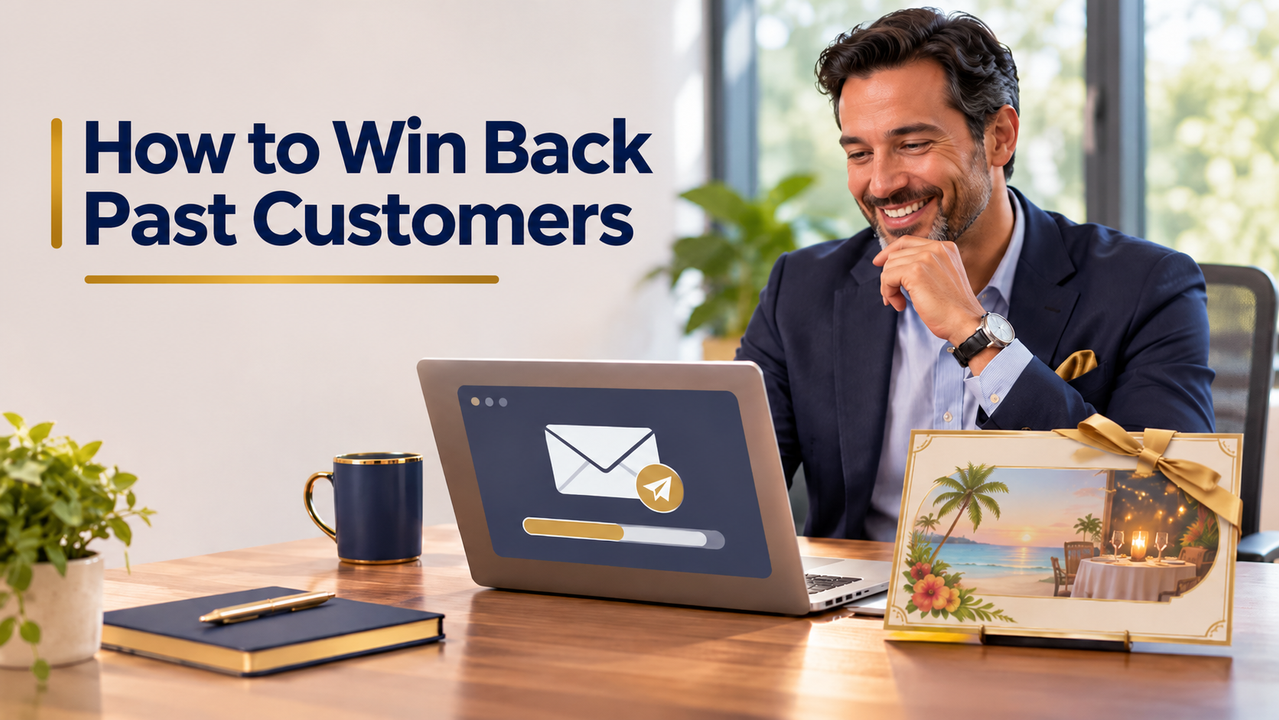
When trying to regain lost customers, you target the correct inactive buyers at the correct time, identify and acknowledge why they stopped purchasing, and provide them with a compelling reason to return without lowering your product prices. Therefore, define "inactive" based on your own business data, separate lapsed customers based upon prior purchase history, send a brief series of emails that adjust based on responses received and monitor whether re-established relationships remain active and continue to generate revenue, rather than simply monitoring whether an email is opened.
To assist you through each step of creating a win-back campaign, this guide walks you through each step with examples you can use to win back both consumer and B2B customers.
What a Win-Back Campaign Is and Who It Should Target
According to HubSpot, a win-back campaign is an effort designed to reattract a customer who has ceased making purchases, stopped utilizing your services or cancelled. HubSpot refers to a win-back campaign as the next step in retaining customers once you have exhausted standard retention tactics. This type of program should be directed toward a customer who was formerly loyal to your brand. However, remember that a win-back campaign is not a blanket promotion directed toward all customers within your entire database. The message, the offer and the timing all depend on the type of customer and why they stopped buying.
Two Types of Customers That Should Be Segmented Separately
Churned Customers: These customers canceled their service subscription, stopped renewing or have clearly moved on from your brand.
Fading Customers: Although these customers still occasionally open an email from your brand, they are much less engaged than they used to be. According to Iterable's win-back guide, fading customers can also be included as potential targets for a win-back campaign. Additionally, it is generally easier to win back fading customers compared to churned customers because they still appear interested in communicating with your brand.
How Long Should I Consider My Customers “Inactive”?
There isn't a universally accepted amount of time. According to Zendesk, determine the length of time you consider customers “inactive” based upon your own customer relationship management (CRM) system, level of engagement and buying habits associated with your industry. For instance, some e-commerce companies suggest using a period of 3 – 6 months as an example of “inactive”. However, according to Klaviyo, the appropriate timeframe will vary based on the type of product sold and average sales cycle.
Practical Methodology to Set Your Own Definition of “Inactive”
Determine the typical gap between repeat purchases made by your repeat customers. Increase that gap by approximately 1.5 – 2 times.
Consider all customers beyond that gap as inactive, and all customers nearing that gap as “at-risk” for a softer nudge.
For example, if your repeat customers normally make repeat purchases every six months, multiply that number by 1.75. Any customer who goes beyond that 10.5-month mark should be considered inactive. On the other hand, any customer who is beginning to reach the 10.5-month mark should receive a gentle nudge. Examples of businesses with vastly different amounts of time between repeat purchases include: a dental clinic with patients scheduled every six months; a contractor who provides services every couple of years; and a software provider whose customers are billed monthly. That is exactly why you must establish your own definition.
Prioritize Customers With the Highest Value
You rarely have the budget to chase every inactive customer. Shopify's enterprise guide recommends prioritizing inactive customers with the greatest value, followed by those who purchased most frequently. Similarly, HubSpot recommends reviewing each inactive customer's transaction history and focusing on those who spent the largest total dollar amount during that period.
RFM Scoring
Create a basic RFM score for each inactive customer, rating them from 1 – 5 on recency (how recently they purchased), frequency (how often they purchased) and monetary value (total amount they spent). Add the three scores together and start with customers who total 12 to 15 out of 15.
Identify Why They Stopped Purchasing Before Creating Any Content
Sending a small discount to an inactive customer who left because of a billing issue or a missing feature will likely not resonate with that customer. First, spend one week identifying why they stopped purchasing.
Where Do the Answers Lie?
Support history: Were there unresolved issues or repeated complaints regarding service? Was response time excessively slow?
Usage/purchase data: When did the rate of usage/purchases decline? What did they cease doing first?
Short Exit surveys/interviews: Open-ended questions like “What was the primary reason you stopped purchasing?” yield better results than lengthy forms with multiple questions.
Account notes/sales history: What was promised at sign-up vs. what actually happened.
Techniques such as asking the “five whys,” enable you to drill down past superficial answers. More often than not, “too expensive,” translates into “I didn't see enough value,” which requires addressing the underlying issue as opposed to providing a price reduction.
Effective Win-Back Strategies & Channels
Regardless of channel choice, effective win-back campaigns involve sequential communications. Acoustic advocates for automated follow-ups that change based on whether the customer opened, clicked or replied.
Iterable recommends using historical engagement data to ensure that inactive customers aren’t contacted on channels they find annoying. In practice:
Email will work for most inactive customers and is usually the least costly medium for testing. SMS will work for customers who provided SMS opt-in permission and utilized SMS before. However, consent must always be obtained before sending a marketing text message. Handwritten letters/direct mail will draw attention for higher-value customers in service industries where email inboxes are overcrowded. Phone calls are worth investing time in for your top-tier inactive accounts particularly in B2B.
Putting Incentives to Work With Creative Marketing Incentives
Utilize vacation and dining certificates as high-value incentives to re-engage customers with your brand without lowering the price of your products or service.
If you want to add a high-value incentive to your win-back sequence without buying or managing the certificates yourself, that is what our platform is for. For example, you email them your win-back sequence but include one extra line: "Come back this month and we’ll thank you with an Airfare + Hotel for Two certificate". Doesn't that sound much more enticing for them than just, "We’d love to have you back"?
What Does Setup Look Like?
Simple. You subscribe, choose from categories that include travel certificates, cruise incentives, dining certificates, hotel savings cards, tangible product incentives and more, and we handle fulfillment and distribution for you. You just simply add the incentive to whatever offer you're running and we take care of the rest. You can browse the incentive categories here.
- #win-back campaigns
- #customer retention
- #lapsed customers
- #repeat business
- #increase sales without discounting
- #incentive marketing